The establishment of ITSO.
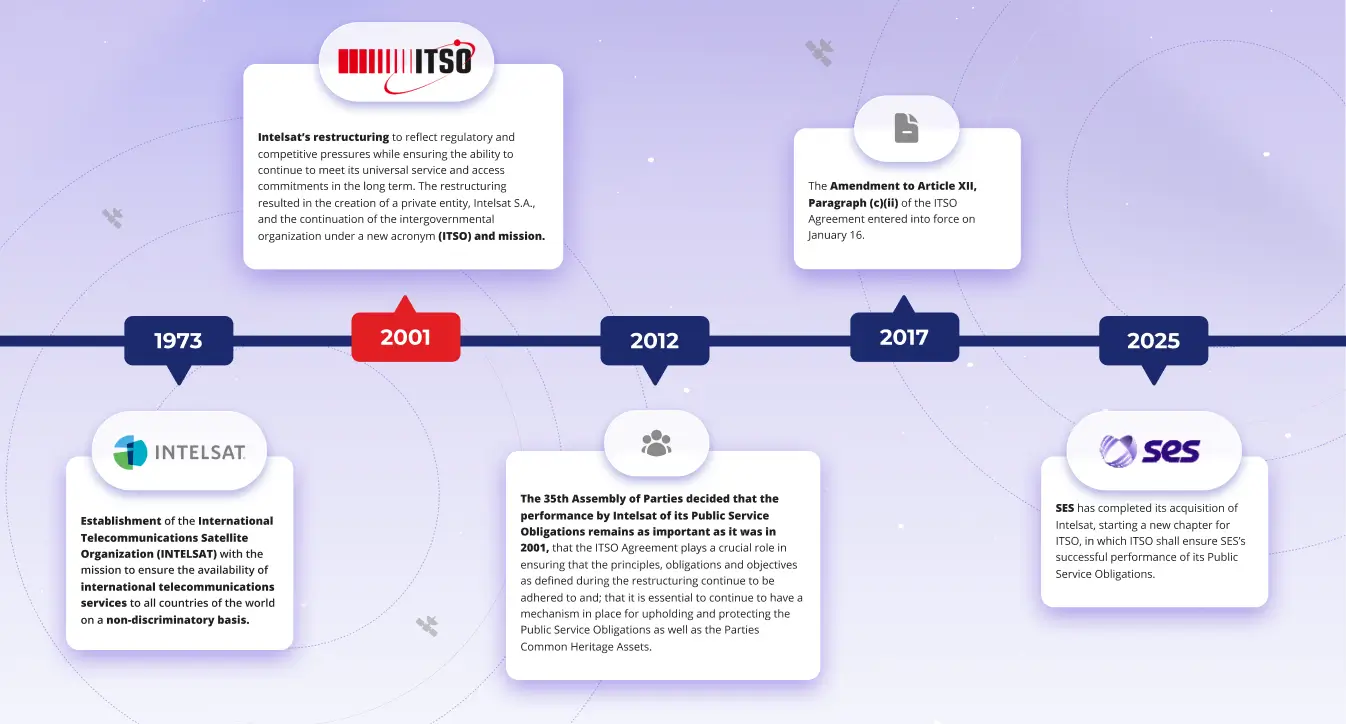
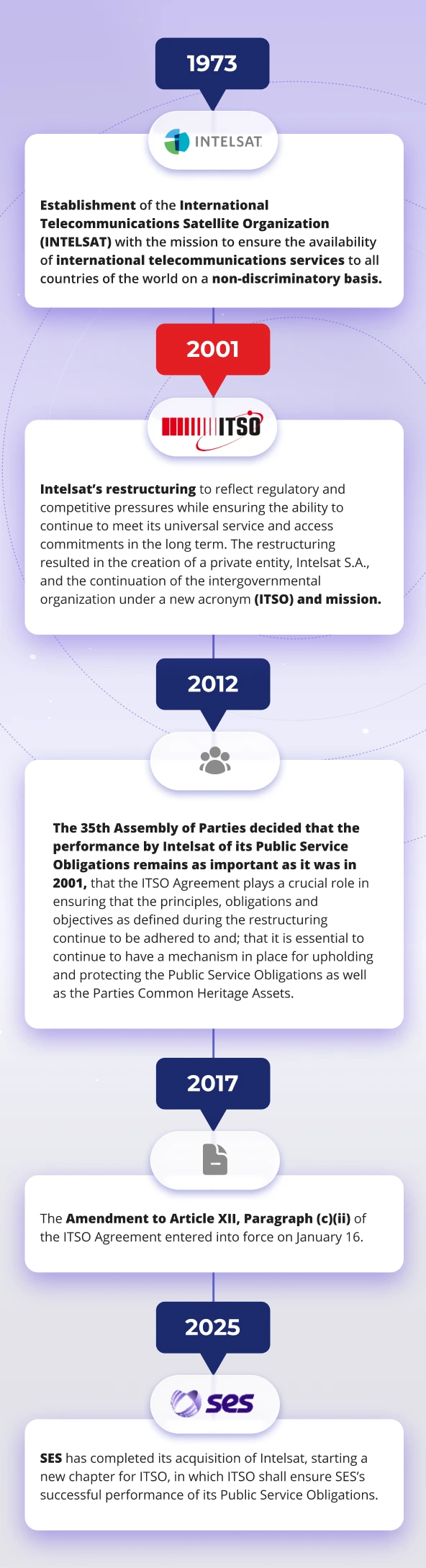
ITSO is an Intergovernmental organization with 149 member states, that incorporates the principle set forth in Resolution 1721(XVI) of the General Assembly of the United Nations, which established that communication by means of satellite should be available to the nations of the world as soon as practicable on a global and non-discriminatory basis. Originally established in 1973 as INTELSAT, the International Telecommunications Satellite Organization was restructured in 2001. The restructuring resulted in the creation of a private entity, Intelsat Ltd., and to the continuation of the intergovernmental organization with a new acronym (ITSO). Since then, ITSO has been responsible for overseeing Intelsat’s compliance with its public service obligations—a role that now extends to SES, following SES acquisition of Intelsat in July 2025. ITSO’s mission is to ensure SES's successful performance of its public service obligations and to safeguard the Parties’ Common Heritage.
Since 18 July 2001, ITSO has been restructured as follows:
The creation of the International Telecommunications Satellite Organization (ITSO), previously known by the acronym, “INTELSAT,” resulted from the efforts of a group of nations to join the United States in 1964 to establish a global communications satellite system. The International Telecommunications Satellite Organization is an intergovernmental organization that incorporates the principle set forth in Resolution 1721 (XVI) of the General Assembly of the United Nations, which establishes that communication by means of satellites should be available to the nations of the world as soon as practicable on a global and non-discriminatory basis. It also incorporates the principle embedded in the “Outer Space Treaty,” which states that outer space shall be used for the benefit and in the interest of all countries. The Organization underwent an important restructuring in 2001 in order to secure the long-term viability of its communications system in a market that is characterized by increasing competition, fast-paced innovations and rising capital costs, and in order to attract private investments. The Assembly of Parties, the highest decision-making body of the Organization, in 2000 approved the legal instruments and framework necessary to create a commercial and pro-competitive company named “Intelsat, Ltd.,” to operate the satellite system and provide space segment capacity in a manner consistent with the core principles of global coverage and connectivity, lifeline connectivity and non-discriminatory access. For this purpose, ITSO transferred its global satellite system and the brand-name of “Intelsat,” to Intelsat, Ltd.
Since this transfer in 2001, Intelsat has invested US$ 2.6 billion to substantially improve the global connectivity and coverage that it offers. As a result, Intelsat’s global communications network, which was composed of 19 satellites in 2001, has expanded to 53 satellites through new launches and acquisitions, while Intelsat simultaneously has expanded its terrestrial facilities, including teleports, points of presence and fiber connectivity. Since its establishment, the Organization has proved to be an efficient catalyst for global cooperation in satellite communications. It has promoted cross-border flows of information that are vital to business, trade and peace, and it has been instrumental in linking the developing countries to the global economy and enhancing the competitiveness of their economies.
ITSO has succeeded in providing high-quality and reliable space segment capacity for public telecommunications services, including telephony, data, video and Internet connectivity, to more than 200 countries and territories, no matter their location, size or level of development. The Organization also has inspired the emergence of dozens of participants at the national, regional and international level in the satellite industry, which today is worth more than US $100 billion.
In accord with its mission, the Organization encourages the creation of a favorable technical and regulatory environment for commercial satellite communications. The Organization coordinates its actions with other intergovernmental organizations such as the ITU, regional telecommunications organizations, as well as telecommunications operators and their associations.
Effective from January 16th, 2017, the amended Article XII, Paragraph (c)(ii) of the ITSO Agreement ensures that if Intelsat or any future entity using the Common Heritage frequency assignments, waives such frequency assignment(s), uses such assignment(s) in ways other than those set forth in this Agreement, or declares bankruptcy, the Notifying Administrations shall authorize the use of such frequency assignment(s) only by entities that have signed a public services agreement, which will enable ITSO to ensure that the selected entities fulfill the Core Principles.
Signed: 20 August 1971
Entered into Force: 12 February 1973

Dr. Renata Brazil-David is the Director General of the International Telecommunications Satellite Organization (ITSO). She was elected at the organization’s Assembly of Parties meeting held in Washington, D.C in October 2024 and assumed the position of Director General of ITSO on July 18 2025.

Ms. Aline Deffry is an accomplished international development professional with 20 years of global experience. She brings strong expertise in organizational development, stakeholder engagement, and capacity building, recognized for her ability to work effectively across diverse cultural and political environments.

Ms. Shivali Shankar is an international development professional, experienced in international cooperation, sustainable development, and climate policy. Prior to joining ITSO, Ms. Shankar worked with the World Bank Group on climate financing initiatives and previously at The Aspen Institute, where she...